

Dust Suppression Using Misting Systems in the Woodworking Industry
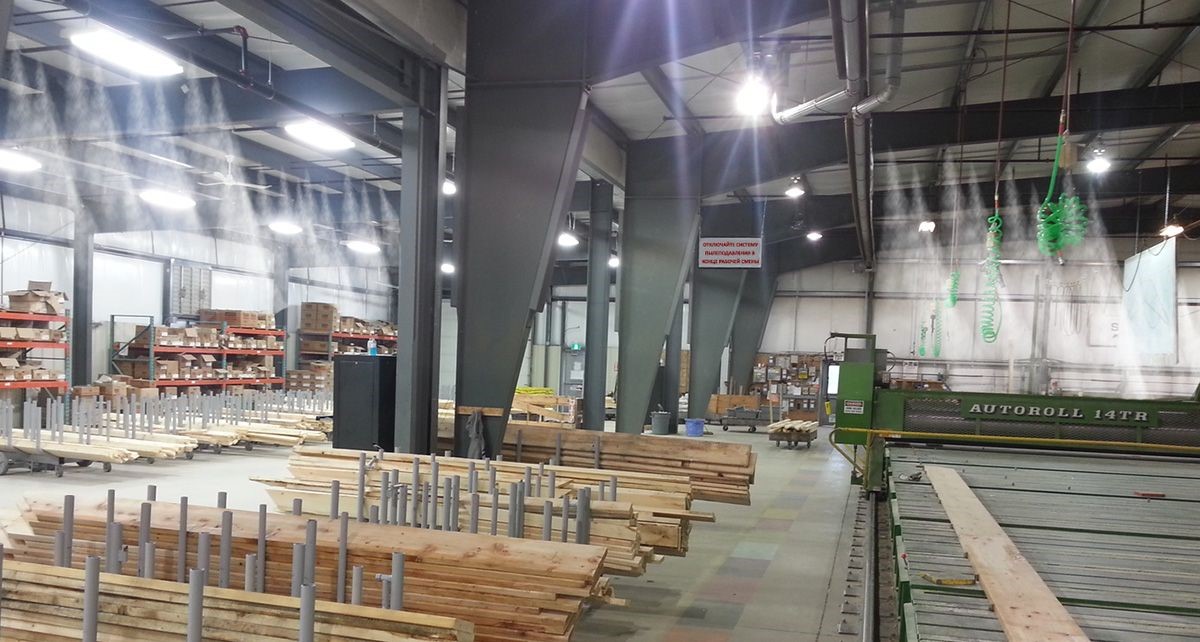
Woodworking workshops and facilities manufacturing wood-based products generate large amounts of dust during processing. Air humidification is also required to maintain a relative humidity level of 50–55%, depending on the specific production process.
To prevent problems such as shrinkage of wooden components caused by drying, followed by deformation, cracking and warping, misting humidification systems should be installed in production facilities. High dust concentrations can also damage furniture components, resulting in product rejection and reduced profitability.
Increased dust levels reduce employee productivity and can lead to more absences due to illness and a higher risk of workplace accidents. Therefore, dust suppression using misting systems is an essential solution for furniture factories and carpentry workshops. Controlling dust that settles on production equipment, clothing, machinery and tools, as well as airborne dust particles, is particularly important because dust can cause damage and equipment failures, reducing overall production profitability.
In furniture factories and wood-based panel manufacturing plants, insufficient humidification can cause production defects. Excessively dry wood absorbs adhesives, paints and varnishes too quickly, which negatively affects the quality of finished products.
Maintaining relative humidity at 50–55% RH provides the following advantages:
· Wood dimensions remain stable
· More efficient production processes
· Faster material processing
· Longer tool service life
· Reduced production downtime
Increasing humidity levels significantly reduces the risk of fires. Airborne dust concentrations can be reduced by more than 70% and, in some cases, eliminated completely. In addition, evaporative cooling creates a comfortable working environment through a process that can be more efficient than conventional cooling systems.

Controlling dust dispersion using misting systems in the woodworking industry helps solve numerous production challenges:
1. Reduced defects and increased productivity – wooden components and finished products retain their original dimensions and proportions, employee productivity increases, and the incidence of illnesses caused by wood dust exposure decreases.
2. Faster material processing – wood becomes easier to machine and process.
3. Dust suppression – reducing dust levels decreases the number of rejected products in furniture workshops caused by scratches and damage to laminated chipboard and MDF panels. It also reduces fire hazards and improves employee well-being.
4. Improved adhesion of wood-based materials – paint and varnish coatings become smoother and more uniform, while bonded components, veneers and laminates maintain stronger adhesion throughout their service life.
5. Cooling of production areas – air temperatures in industrial facilities can be reduced by 5–12°C through the evaporation process, which acts as a natural cooling system.
6. Increased profitability – higher revenue through the optimization of production processes and reduced costs associated with maintenance, cleaning and keeping facilities in good condition.
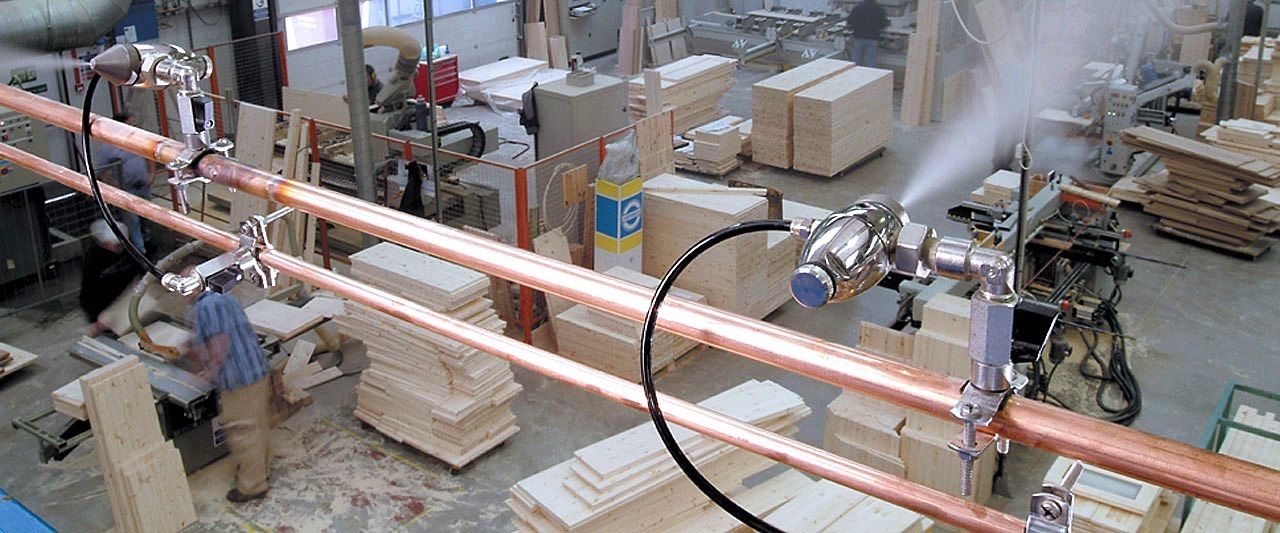
To prevent wooden materials and finished wood and paper products from becoming wet, the use of a high-pressure misting system is recommended. Such a system consists of the following components:
- High-pressure pump;
- High-pressure tubing system;
- Fine misting nozzles;
- Fittings and connectors;
- Water filters installed on the supply line;
- Mist distribution fan (if required);
- Misting system control unit;
- High-pressure ball valves;
- Drain valve;
- Mounting clamps and other components according to the project specifications.

These systems can be installed both indoors, including directly on production equipment, and in outdoor areas. The system generates a large quantity of fine water droplets that attach to dust particles, increase their weight and cause them to settle. In open areas, a dense mist curtain can be created to prevent dust from spreading.
Misting dust suppression systems help control wood dust generated during the cutting and processing of wood and chipboard in industrial facilities. They also help reduce manufacturing defects and fire risks.
Misting dust suppression systems are easy to install and do not require complex technical maintenance. They also offer low energy consumption and quiet operation.
This allows the system to be designed and installed without interrupting production processes or causing operational downtime.