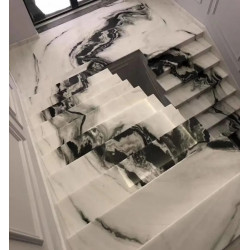

The main requirements that stairs must meet are sufficient-precise throughput, fire resistance, load-bearing capacity and
rigidity.
Stairs consist of floor and intermediate platforms and marches.
Minimum width of staircases (the distance between the wall and
railings or between two railings) and their maximum permissible slope
(the ratio of the height of the march to the length of its horizontal projection )
are determined based on the requirements for the evacuation of people in case of fire and when-
are listed in Appendix A.
The number of steps in one march is accepted at least 3 and no more than 16;for stairs leading to basements or attics, a larger number is allowed
steps.
All steps within the same march must be the samesize in height and width.
The convenience of the steps is checked by specialformulas:
1 Step formula:
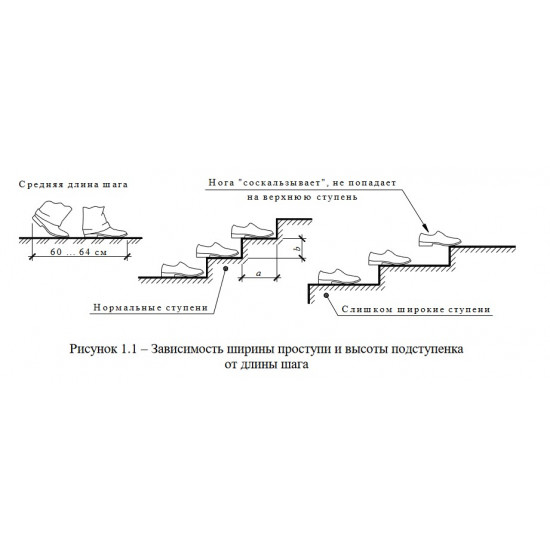
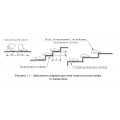
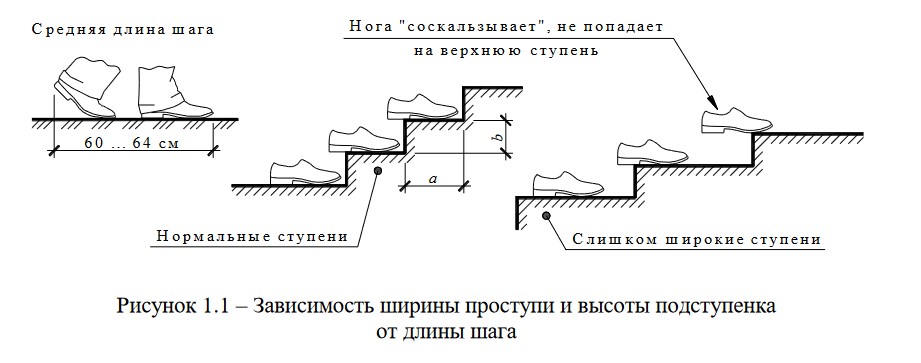
This means that the tread width (a) and the riser height (b) must
match the average human stride length (60-64 cm)
Safety formula: a+b = 46+-1cm
Convenience formula: a-b=12 cm
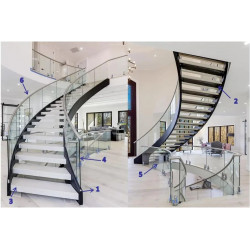
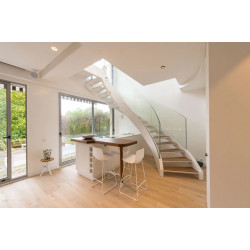
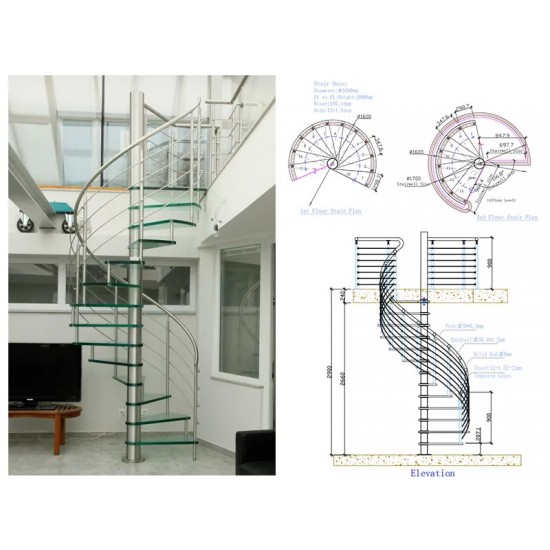
Such ladders are divided into straight quarter-turn (with a 90 ° angle of rotation of the marches), semi-turn (180 °) and circular, which make a full turn, that is, 360 °.
Often ladders with a 90° angle of rotation of the marches are installed along two walls, and small storerooms or cabinets are equipped under the marches and the platform.
That is why the staircase is divided into parts and equipped with intermediate platforms so that you can stop and take a breath.
It has long been noticed that when there are more than ten steps, it is inconvenient to climb the stairs
A march is called a continuous series of steps.
Stairs with straight marches are traditional. They are easy to manufacture, and convenient and reliable in operation. Depending on the dimensions of the premises, their layout and purpose, such stairs can be one-, two- or multi-step.
Stairs with straight flights
For a closed staircase, you will also need risers. The configuration of all the elements of the staircase and their decorative design is a matter of aesthetic preferences. However, the staircase should not only be beautiful, but also, no less important, comfortable, reliable and safe. To do this, when designing stairs, it is necessary to comply with certain requirements, the most important of which is the compliance of the parameters of the stairs with certain rules and regulations. We will tell you about some of them in more detail. The convenience of the ladder and the associated safety of its operation depend primarily on the relative magnitude of the rise of the march. The latter is characterized by the ratio between the height S and the depth A of the step (or, as they often say, between the height of the riser and the depth of the tread). This ratio depends on the angle of inclination of the march, which can be determined graphically, knowing the position of the stairs in the plan and the height of the room, as well as on biologically specified values: the length of a person's step on the plane and a convenient leg lift.
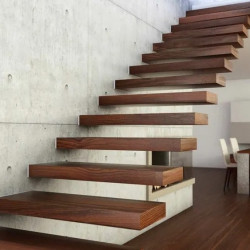
The basis of the ladder is its supporting elements - bowstrings or scythes.
A necessary set for any staircase: steps, support posts at the beginning and at the end of each march, and between them - a handrail with balusters.
CONSTRUCTION AND DESIGN OF STAIRS